

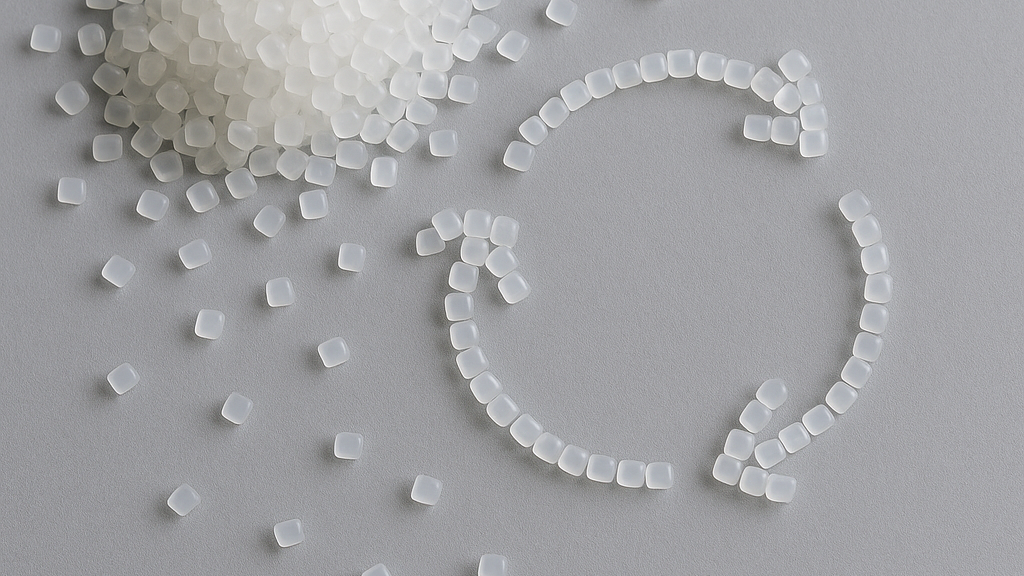
As an injection moulding partner and contract manufacturer within the industrial sector, we collaborate closely with our material suppliers and customers to develop sustainable and technically advanced product solutions. We see it as our responsibility to contribute to a more resource-efficient and circular future.
Up to 60–80% of a plastic product’s total climate impact arises already during the production of plastic granulate. For this reason, we actively work together with our customers and material suppliers to replace conventional materials with recycled or bio-based plastics; without compromising functionality or technical performance.
Recycled plastics – multiple pathways to circularity
There are several types of recycled plastics, each with different properties and areas of application:
- Mechanical recycling
The most common and energy-efficient method. Plastic waste is ground, washed, and converted into new granulate. However, the process requires clean and well-sorted material streams to achieve high-quality results. - Post-industrial material
Production scrap from industrial manufacturing – plastic that has never left the factory. These materials typically maintain very high quality and are well suited for reuse in new products. - Post-consumer material
Plastics collected from end users, such as used packaging. After sorting and cleaning, these materials are recycled into new raw materials. - Chemical recycling
A method that breaks down plastic into its original chemical components. This enables the recycling of mixed or contaminated plastic waste that is not suitable for mechanical recycling.
More than just material selection
Our sustainability efforts extend beyond choosing the right type of plastic. We have a long-term ambition to reduce our overall resource consumption – both in terms of energy and raw materials. All electricity used in our production comes from 100% green, renewable, or recycled energy sources, primarily from biomass.
However, working with recycled materials also involves certain technical challenges. Recycled plastics may contain impurities such as dirt, additives, or other polymer types, which can affect material properties and limit colour options. In mechanical recycling – where plastic is melted and reprocessed – the polymer chains gradually degrade. This impacts key properties such as strength, impact resistance, and heat resistance, making material performance more difficult to predict. Achieving the required performance often demands careful sorting, the addition of stabilisers, or blending with virgin material – factors that increase both cost and complexity.
In our own production, we also recycle sprues – an unavoidable by-product of the injection moulding process – by grinding and reusing up to 20% of the product’s weight. This is done without compromising the material’s technical performance.
Through these initiatives, we aim not only to reduce our own environmental impact but also to contribute to a broader industrial transition. Our ambition is to be a driving force for a more circular and responsible industry – and to inspire others to take active steps in the same direction.